Philosophy — the evolution of an idea
Ideafy is built on one observation: software is the frozen form of an idea that survived. Everything else — the kanban, the AI tooling, the worktrees — is infrastructure for watching that survival happen, out loud, step by step.
This page is the "why." If you want the "what," start with Overview. If you just want to use the tool, start with Install. What follows is the philosophical spine that every other design decision bends around.
Ideas don't arrive finished
The most romantic story about building software is that you get an idea, you sit down, and you ship it. Nobody actually works that way. Ideas arrive soft, partial, and half-wrong. They have to be pressure-tested, cut down, argued with, planned, and rebuilt — often several times — before they become anything you can point at and call a product.
If you've ever kept a notebook of ideas that never happened, you already know this. The notebook isn't the problem. The problem is that the notebook has one column: "ideas I had." There's no column for "ideas I decided were worth doing." No column for "ideas I thought about for three days and rejected." No column for "the idea I was actually building when this one arrived." The notebook can't track the evolution. It only tracks the birth.
Ideafy's bet is that the evolution of an idea is the thing worth tracking, and that if you give an idea the right structure at each stage, it will tell you — on its own — whether it deserves to become code.
Chain of thought, for products
In reasoning, "chain of thought" means: don't jump from the question to the answer; show the intermediate steps, out loud, one at a time. It turns out this is more useful when the problem is hard. The intermediate steps aren't decoration — they're what makes the reasoning reliable. A chain of thought you can read is a chain of thought you can correct.
Product work is the same. "I have an idea" → "it's shipped" is not a single step. It's a chain:
- I have a rough thought. (Does this belong in my project at all?)
- I have an opinion about it. (Is it worth doing? What's the verdict, with reasons?)
- I have a scope. (What exactly does this become?)
- I have a plan. (What code changes, in what order?)
- I have an implementation. (Does the code exist yet?)
- I have acceptance tests. (How will I know it's done?)
- I have a shipped thing. (And I know when.)
Each link in the chain is a different kind of thinking. Each has its own natural stopping conditions. Skipping a link doesn't save you time — it transfers the cost to a later stage, usually at a worse exchange rate.
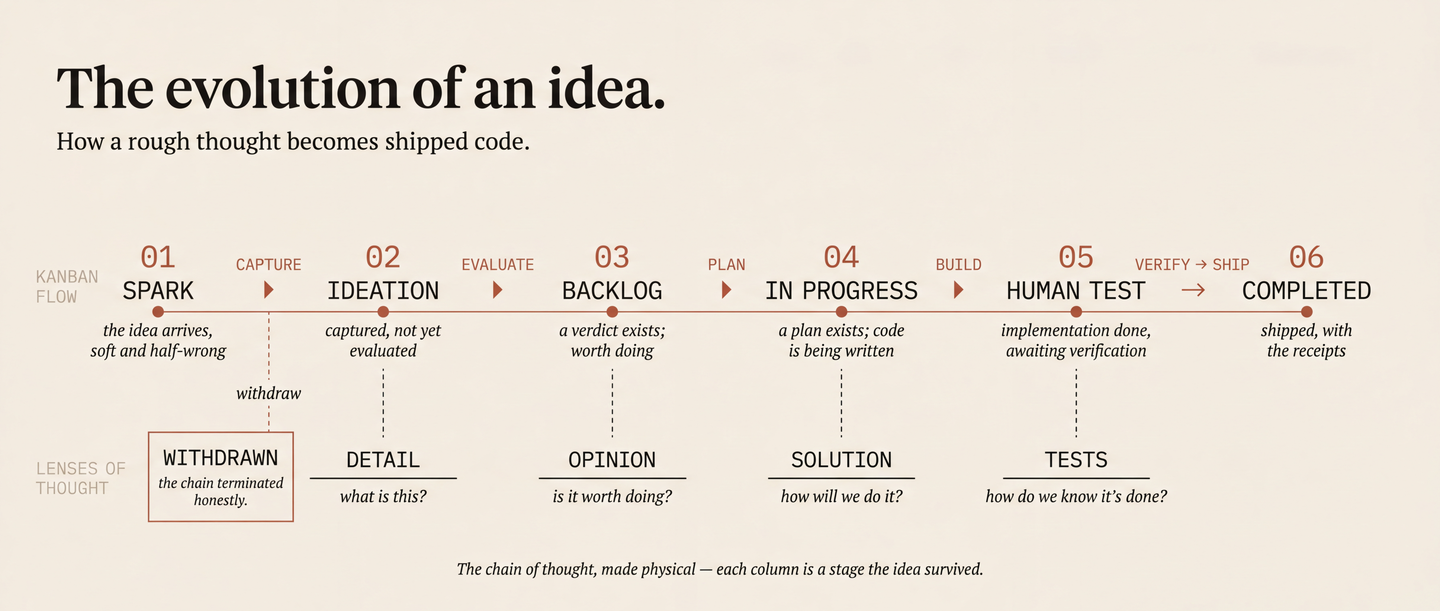
Ideafy's six-column board is not an arbitrary taxonomy. It's this chain made physical:
- Ideation — rough thought. No scope yet, no plan, no obligation
- Backlog — scoped and opinion-formed; a real candidate
- In Progress — a plan exists; implementation is underway
- Human Test — implementation done; verification pending
- Completed — shipped
Plus Bugs (a different evolution: from "something's wrong" to "it's fixed") and Withdrawn (the ideas that survived evaluation but not prioritization — the chain terminated honestly).
A card moves right when its owner has done enough new thinking to deserve the next column. Not when the calendar says so. Not when a standup says so. When the thought has actually evolved.
Four lenses on the same card
Each card has four tabs — Detail, Opinion, Solution, Tests. They're not arbitrary either. They're the four angles you need to look at a piece of work from, and they correspond to four different questions you'd ask about any idea:
| Tab | Question | Kind of thinking |
|---|---|---|
| Detail | What is this? | Description, constraints, context. The idea as given. |
| Opinion | Is it worth doing? | Evaluation against goals, non-goals, risks. The verdict. |
| Solution | How will we do it? | Plan, sequence, files touched, trade-offs. The blueprint. |
| Tests | How do we know it's done? | Acceptance criteria. The finish line, written before the finish. |
You could write all four into a single "description" field. People do. But collapsing them collapses the thought. You stop being able to tell the plan from the opinion from the acceptance criteria, and the card degrades into a wall of text nobody reads twice. Separating the lenses is what keeps each one honest.
It's also what makes a card legible to a second reader — whether that's a teammate tomorrow or an AI agent right now. A second reader can ask "what's the plan?" and get exactly the plan, not a story about how the plan was arrived at. That single property — structured enough for a second reader — is what turns a card from a reminder into an executable unit.
The agent as a participant in the chain
Most tools treat AI as a feature you visit: a chat panel, a generator, a button. Ideafy treats the agent as another link in the chain. When you ask the agent for an opinion, it writes the Opinion tab. When you ask it for a plan, it writes the Solution tab and moves the card to In Progress. When it finishes implementation, it writes the Tests tab and moves the card to Human Test.
The agent isn't doing the thinking for you. It's doing the thinking alongside you, in the same structure, against the same board. You read what it produced at each stage, correct what's wrong, and move on. This is the cheap-fast-good triangle rotated: the agent pays the time cost of turning rough thoughts into structured ones, and you pay the judgement cost of deciding what to keep.
This is also why Ideafy resists the temptation to give the agent free rein. Autonomous mode exists, but Human Test is a column for a reason: the chain of thought has to pass through a human verifier before it's allowed to terminate at Completed. The gate isn't a bureaucratic hurdle — it's the last chance for the chain to correct itself before the idea is frozen into code.
Why "card" is a load-bearing word
A "ticket" (the Jira word) implies you're transacting: something to do, hand it off, close it. A "task" (the Todo-app word) implies you're a worker executing a plan made earlier. A "card" (the Ideafy word) implies something more neutral: a stable surface on which thinking happens over time.
A card isn't a transaction and isn't a task. It's the container that evolves alongside the idea. When you read a card in Completed, you're not reading a ticket; you're reading a preserved chain of thought — the detail, the opinion, the plan, the tests, the conversation history with the agent, the git branch, the merge commit. Nothing has to be reconstructed later because everything was written down while the thinking was happening.
One consequence: never delete cards you decided not to ship. Drag them to Withdrawn instead. The chain terminated, but the reasoning survives, and three months later when the same idea walks in dressed differently, you'll have the receipts.
The three commitments
If philosophy is load-bearing, it should imply commitments. Ideafy makes three.
-
Structure over freeform. The card's fields are strict on purpose. Detail is not Solution. Solution is not Tests. Tests are not Opinion. The separation is an act of respect for thought, not a form-filling exercise.
-
Evolution over assignment. The pool (in the Team edition) is pull-based, not push-based. A card moves to the person who picks it up, not to the person you nominated at creation time. Assignment-first workflows pretend that the thinking is already done ("now just do it"). Evolution-first workflows admit that the thinking is still happening.
-
Preservation over tidiness. Conversations are kept. Withdrawn cards stay. Git history on merged branches is retained. Cleanliness is for filesystems; chains of thought have to survive so future-you can read them.
A note from the author
I've spent roughly twenty years building enterprise software — shipping it, consulting for teams that were trying to ship it, and watching how large organisations turn ideas into code. That whole time, one thing stayed consistent: the ability to form a complex, structured, durable chain of thought about a product was the exclusive property of a very small group of specialists. Architects. Lead engineers. Senior analysts. A handful of people who could hold the whole problem in their head and walk it from "rough idea" to "production system" without the thread snapping.
Everyone else — product people, business analysts, founders without a technical co-founder, domain experts, people with exceptional ideas but no way to wire them into software — was structurally locked out. Not because they had nothing to contribute; because the distance between "I have an idea" and "the idea is running on a server" required a kind of clustered, disciplined thinking that enterprise-grade tools didn't teach and enterprise-grade processes didn't democratize. They just enforced.
Then AI changed the unit economics of this. Ideas and opportunities are, for the first time in my career, actually democratized. A founder with taste can prototype in a weekend. A business analyst can close a bug without filing a ticket. A domain expert can describe a workflow in plain language and have working code thirty minutes later. That much is real, and it's already happening.
But I don't think the shift we're watching is "everyone uses AI." Using a tool is not a new skill — we've always used tools. The shift I care about is "everyone collaborates with AI as a team — and inherits an enterprise-grade chain of thought capability they never had access to before." The difference between using an AI and being in a team with one is the same difference as between typing a query into Google and pair-programming with a senior engineer. One is a transaction. The other is a chain of thought shared between two minds, held together over time, with structure.
This is what I wanted to build a tool for. Not AI as an assistant on the side. AI as a team member inside a disciplined surface — columns, plans, tests, verifications — where the chain of thought that used to belong only to enterprise architects becomes something a product owner, a founder, an analyst, or a first-time builder can inhabit. Ideafy is my attempt to bring people one step closer to that. It's not going to get the whole way there by itself; no tool will. But if it makes the structured, collaborative, chain-of-thought mode of working feel normal for one more person who couldn't have accessed it before, it was worth building.
— Ozan
What Ideafy is not
- It is not a ticket tracker. Ticket trackers optimise for assignment and closure. Ideafy optimises for thinking out loud.
- It is not an AI pair programmer bolted onto a todo list. The agent is wired into the same chain of thought you're in; it's not an accessory.
- It is not a project management tool for cross-functional work. It is for people turning ideas into code.
- It is not a replacement for judgement. The chain of thought still has to pass through you.
Prev: AI Manifesto Next: Install Up: User guide index